

Overview
On the morning of 5 May 1957 Joanna Pollock, aged 11, and her sister Jacqueline, aged 6, were walking to Sunday school in Hexham, Northumberland, with a young friend when a woman deliberately drove her car onto the pavement and ran them down. All three children died. The driver, who according to the girls’ father had recently been parted from her own children, was later committed to a mental hospital. Despite the gap in age the sisters had been inseparable, with Joanna mothering Jacqueline.1
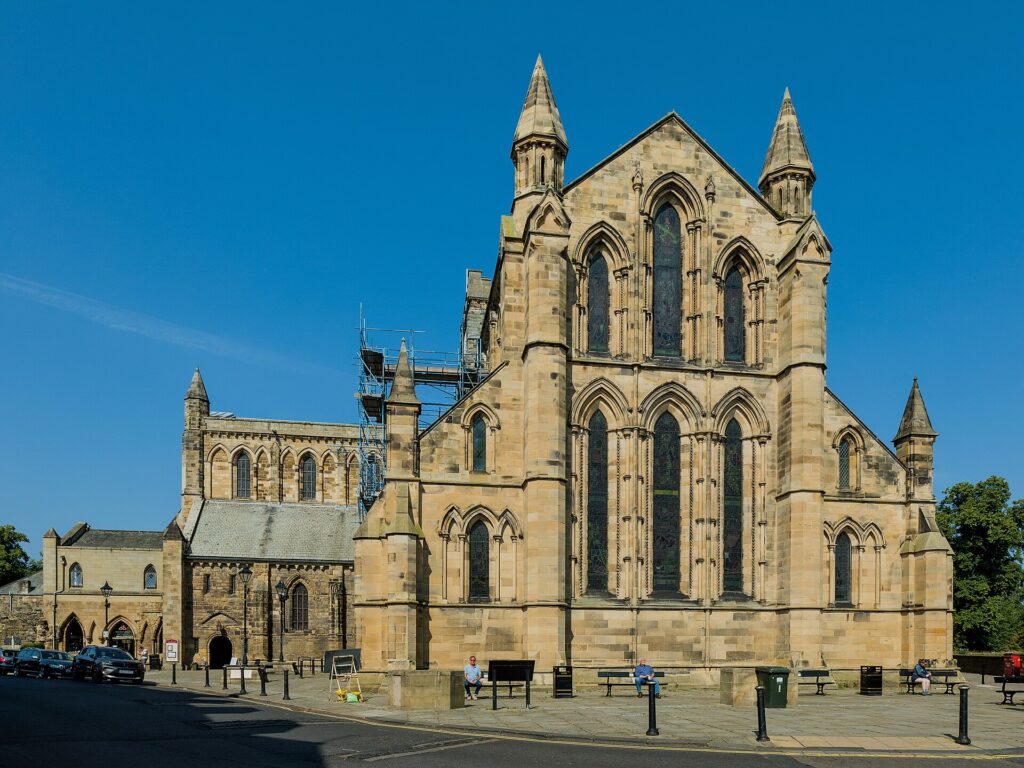
Their father, John Pollock, had believed in reincarnation since boyhood and became convinced that the girls would return to the family. When his wife Florence became pregnant again he insisted she would have twins, although she and her doctor, who could hear only one heartbeat, expected one baby. On 4 October 1958 she gave birth in Hexham to Gillian and, ten minutes later, Jennifer. Blood tests in 1978 showed that they were almost certainly identical twins.12
Birthmarks and physique
At about three Jacqueline had fallen onto a bucket and cut her forehead just above the bridge of her nose; the wound needed three stitches and left a scar. At birth Jennifer had a mark at the same spot, slightly depressed like the scar and, like it, more noticeable in cold weather. It faded but was still visible when she was twenty. She also had a round, darker mole about a centimetre across on her left waist, where Jacqueline had had a similar one. Gillian had neither mark, and no one else in the family had the mole.1
The twins’ builds also echoed the sisters’: Gillian was slender like Joanna, Jennifer stockier like Jacqueline. Gillian walked with her feet turned out, as Joanna had. When they began to write at about four and a half, Gillian held her pencil properly while Jennifer clutched it in her fist, as Jacqueline used to, a habit she still sometimes showed at 23.12
Statements and recognitions
The twins were slow to talk, and between about three and seven they said and recognised only a little, Gillian appearing to remember Joanna’s life and Jennifer Jacqueline’s. When the sisters’ toys were brought down from the attic, Gillian took Joanna’s doll and Jennifer took Jacqueline’s, saying Santa Claus had given them, and Gillian claimed Joanna’s toy clothes wringer. Gillian pointed to the mark on Jennifer’s forehead and said it was where she had fallen on a bucket, which Jennifer never had. At about four and a half Jennifer asked why her father was wearing ‘mummy’s coat’ when he put on a smock Florence had worn on the milk round before the deaths, and said her mother had worn it to deliver milk; Gillian did not seem to recognise it.1
On their first visit back to Hexham since leaving as babies, the twins asked to cross to the swings in the park before these were in sight. Later they insisted they had stayed for lunch at school in Hexham, as the older girls sometimes had. Florence heard them talking together about the accident and remembered one saying that blood had streamed down her face; John recalled that Jacqueline’s head was bandaged when he identified the bodies. One twin said a doll was called Mary, which could not be confirmed.1
Behaviour
Both twins were afraid of vehicles. Florence said they held her hands crossing roads, unlike their sisters, though she thought her own nervousness might explain it, and John saw them cling together in terror when a car started up in an enclosed alley near their home. Like their sisters, both liked combing their father’s hair and turned to their grandmother rather than their mother for care, even though Florence had stopped work and was now at home with them. Gillian mothered Jennifer, was more independent and generous, and liked dressing up and acting, as Joanna had.12
Investigation
Ian Stevenson learned of the case from newspaper reports in spring 1963 and met the family in Whitley Bay that August, then in Scarborough in 1967 and 1978, and saw John Pollock again in 1982; they corresponded until John’s death in 1985. The parents were the only informants. Stevenson recorded the first ten items in 1963, before the twins were five, and examined Jennifer’s birthmarks then, but did not talk at length with the twins until they were adults. He left out four further place recognitions that John recalled only in 1982. He reported the case in detail in Reincarnation and Biology and more briefly in European Cases of the Reincarnation Type.12
Assessment
Stevenson accepted that John Pollock’s strong expectation might have coloured what he noticed and reported, and said he was willing to discount much or all of the statements and recognitions. John’s answer to a sceptical journalist was that without that belief he would simply have ignored the twins’ remarks. The writer Ian Wilson also discussed the case critically.123
What Stevenson found hard to explain were the differences between twins with the same genes: Jennifer alone had two birthmarks matching a scar and a mole of Jacqueline’s, and the twins’ builds, gaits and behaviour matched the two sisters. He did not think parents, however much they wanted their daughters back, could have moulded such behaviour. Since Florence had not expected the girls to return, he thought a ‘maternal impression’ unlikely, and saw a ‘paternal impression’ from John’s intense expectation as the main alternative to reincarnation. He counted the case among the strongest evidence he knew for reincarnation.12
Later life
By 1978 the twins remembered nothing and were mildly sceptical, though they did not dispute their parents’ accounts and took part in a 1979 television programme on the case. In 1981 Gillian described a vision of playing in a sandpit in the garden of a large house, which fitted the family’s former house at Whickham, their home in Joanna’s early years, long before the twins were born. Both left school at about sixteen to work as clerks in food shops. Florence died early in 1979; Jennifer married the following year, while Gillian stayed with her father.1