

Overview
Purnima Ekanayake was born on 24 August 1987 in Bakamuna, a small town in the Polunnaruwa district of central Sri Lanka. Her father was the principal of a secondary school and her mother was also a teacher. Soon after the birth her mother noticed a large cluster of pale birthmarks on the left side of Purnima’s lower chest, and remarked lightly to her husband that they might come from an accident in a previous life.1
From about two and a half or three, in 1990, Purnima began to talk about a previous life. Her first remarks were indirect: people who run others over in the street, she said, are bad. When her mother was upset by a road accident near their home, Purnima told her not to worry, since she had come to her after an accident like that, and said a ‘heap of iron’ had been on her body. Her parents paid little attention until early 1993.1
The statements
According to her parents, Purnima made twenty statements before the previous family was found. She said her family made incense and had no other work, that they made the Ambiga and Geta Pichcha brands, and that the factory was near a brick kiln and a pond. She said she had been the best incense maker and had had two wives, named her mother as Simona, and said she had gone to Rahula School up to the fifth grade. Her parents assumed the brand names came from a jewellery advertisement and the jasmine in their garden; no shop in Bakamuna sold either brand. In play she would walk about with her hands behind her back, as if inspecting workers.1
She also described what happened after the accident: for a few days she floated in semi-darkness among many others, saw people crying for her and watched her body up to the funeral, then saw a light and came to her new home. Haraldsson had found memories of the time between lives in only one other Sri Lankan case.1
Identification
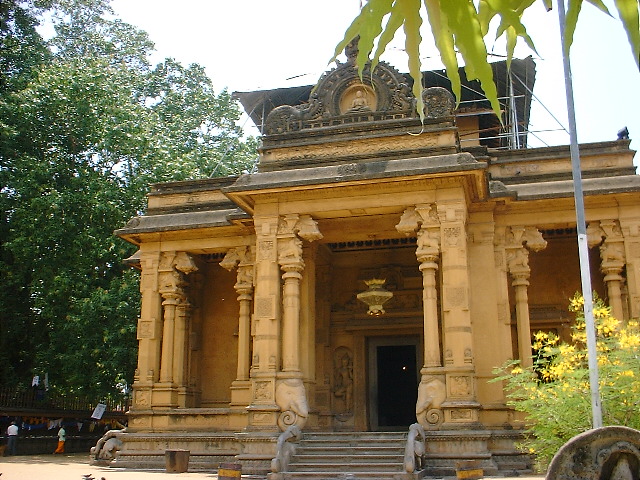
At about four Purnima saw a television program about the Kelaniya temple near Colombo, nearly 145 miles away, and said she recognized it. When her parents later took a school party there, she said she had lived on the other side of the Kelaniya river. In 1993 W. G. Sumanasiri, a newly appointed teacher in Bakamuna who spent his weekends in Kelaniya, agreed with her father to make enquiries. He had not met Purnima, and her father gave him four points to check: the river, the two brands, selling incense from a bicycle, and a fatal accident with a big vehicle.1
Crossing the river by ferry, Sumanasiri found three small family incense businesses. One, run by L. A. Wijisiri of Angoda, made Ambiga and Geta Pichcha. Wijisiri’s brother-in-law and partner, Jinadasa Perera, born in 1949, had been killed in 1985 when a bus hit him as he took incense to market by bicycle. Jinadasa had lived for some years with Wijisiri’s sister, then left her for a woman in the south, returning to Angoda to help after Wijisiri was injured; he was killed a few days later. He had married neither woman legally, but in Sinhalese usage both counted as wives.1
The first meeting
A week or two later Purnima and her parents made an unannounced visit to Angoda. On the way she whispered to her mother that the incense dealer had two wives, and that this was a secret. According to Wijisiri, as he walked up to the house she named him and said he was her brother-in-law. She asked whether the packet design had changed, which it had, mentioned an old injury to his knee that Jinadasa had treated, and named Jinadasa’s friends Somasiri and Padmasiri. She also knew that the family had moved home and factory within Angoda, and named Nugegoda as the place of the accident. Somasiri and Jinadasa’s sister Violet said she pointed them out as her friend and her younger sister.1
Birthmarks
So far as her parents remembered, Purnima had not linked her birthmarks to the accident before meeting the family. At Angoda she said the bus’s tyres had gone over her chest and pointed across the left side, where her marks are, and someone in the family said Jinadasa had been injured on the left side of his body. His brother, who identified the body, described massive injuries running up and across from the lower left ribs.1
None of those involved had seen the post-mortem report. Haraldsson obtained it with the court’s permission. It recorded many broken ribs, mostly on the left, a ruptured liver and spleen, and a long graze running diagonally across the chest to the lower left abdomen. Purnima’s birthmarks lie within this area, where, Haraldsson noted, most of the ribs broke and Jinadasa probably felt the most pain.1
Investigation and assessment
Erlendur Haraldsson first met Purnima in September 1996, when she was nine, and interviewed her parents several times over three years, as well as Jinadasa’s family, friends and neighbours. Of the twenty statements he found fourteen correct, three wrong and three impossible to check. Jinadasa had gone to Rahula School, but it had no two-storey building in his day; his mother did not seem ever to have been fair; and his father had not told him to leave school to make incense. Purnima also explained how incense is made, from charcoal or cow dung on gummed bamboo sticks, which her parents did not know and which matched Wijisiri’s method.1
Haraldsson judged the case to be of unusual quality: the families were strangers who lived far apart, a third party traced the previous person, and the memories, birthmarks and skill fitted together. Its main weakness, he wrote, was that nothing was written down before the case was solved, three years before his investigation began. Unusually, Purnima was still speaking of the previous life at ten. He described her as gifted, independent-minded and much concerned with neatness.1 The case was later featured in the Channel 4 documentary Children’s Past Lives (2000).2