

Overview
Cameron Macauley was born on 23 August 2000 near Glasgow and grew up there with his mother, Norma, and an older brother. From about two and a half he talked of another family on Barra, a small island in the Outer Hebrides with little more than a thousand people, which his family had never visited and had no links with; his mother had to find it on a map. He talked about Barra daily at nursery, asked for his ‘Barra mum’ to collect him, and cried that his other family would be missing him. His brother, brought up alongside him, never spoke of a past life.12
What he said
Before anyone tried to check, Cameron said his Barra father was called Shane Robertson, had black spiky hair, and had stepped into the road without looking and been killed by a car while Cameron was with him. His Barra mother had long brown hair that she later had cut short. He had three brothers and three sisters. The family lived in a large white house near the beach, with several toilets and stacks of boxes outside, and had a black dog with white on its chest. He swam in rock pools, kept away from the crabs, used a black dial telephone and watched planes land on the beach. He never described being an adult, and said that he ‘fell through’ a hole and came into his mother’s tummy.12
Investigation
October Films, making a television documentary, found the family through a newspaper advertisement and called in Jim B Tucker. Tucker interviewed Norma and Cameron in Glasgow in February 2006 and wrote down Cameron’s statements before the trip to Barra. Some details had shifted: the car was now blue and green rather than green and silver, and the house had one storey, though he had earlier mentioned stairs. Tucker, who gives more weight to earlier statements, wondered whether the attention of the film crew had revived the memories and added errors. Cameron’s uncle said his story had been consistent for three years.1
Tricia Robertson, asked to look into the case by Mary Rose Barrington of the Society for Psychical Research, interviewed the family separately with Archie Roy, recording each interview on video. She spoke to the uncle, who remembered Cameron talking from an early age about the house, its three toilets and the rock pools, and in April 2007 to a neighbour who confirmed he had talked of Barra for as long as she could remember.2
The visit to Barra
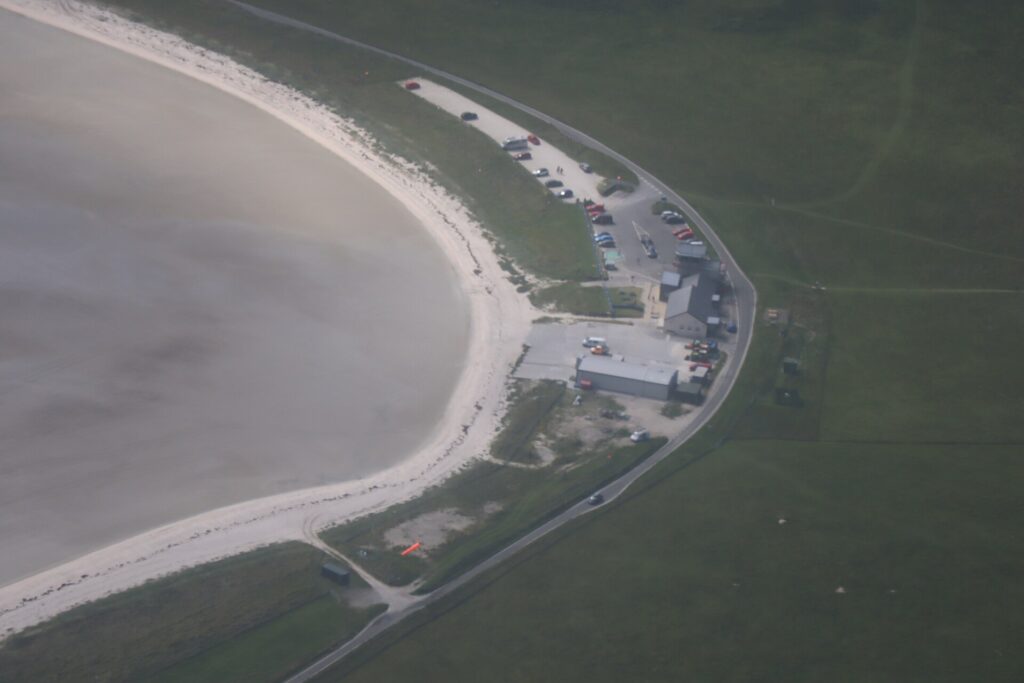
The party flew to Barra, whose airport is the only one where scheduled flights land on a beach, and Cameron told his brother he had said it was true. The local historian, Calum MacNeil, knew of no one killed as Cameron described and no Shane Robertson. He added that more than one toilet would mean a fairly recent house, and that only from the north end of the island could one watch planes land. He then found that a Glasgow shipping family named Robertson had owned a holiday house there, the Sanderling, a large white house near the shore at the north end, in the 1960s and 70s.1
Tucker saw Cameron fall silent and look downcast on first seeing the house. Robertson’s account adds that he pointed the house out from the road before being told, showed a hidden path to the beach, went straight to its three toilets and said there was no upstairs when his mother assumed there was. Inside he became sad, and later admitted he had thought his family would be there.12
The Robertson family
Through a genealogist the film-makers traced a member of the Robertson family who had spent holidays on Barra as a child. She confirmed that the couple who looked after the house had a black-and-white sheepdog, and her photographs showed the dog, a big black car and many children. But there had been no Shane Robertson, no one in the family had been killed by a car, and no child had died young. Robertson writes that Cameron had said before the trip that the Robertsons lived in Glasgow and used the house for holidays; Tucker does not record this.12
Assessment and later life
Tucker found that Cameron had given accurate details of Barra but wrong ones about his family, so the case remains unsolved. He did not think a television program about Barra explained the strength of Cameron’s feelings, and noted that Cameron scored 1 on the Child Dissociative Checklist, where 12 or more suggests significant dissociation. He suggested that ‘Shane’ might reflect the Gaelic word for old or grandfather, that the investigators may have seized on the Robertson name too quickly instead of looking for a family whose father was killed by a car, or that Cameron had mixed memories of two lives.1 The psychologist Chris French, interviewed for the documentary, suggested false memories shaped by other sources.3
Norma found the trip good for Cameron, who afterwards was calmer about Barra and said he had nothing left to prove. By 2007 he told Robertson that it was sometimes hard to remember.12