

Overview
Ampan Petcherat was born in March 1954 in Song Klong, a market town about 37 kilometres south of Bangkok in a district crossed by klongs, the canals that were then the main way of getting about. When she was about a year old she began telling her mother that she had another mother and father at Klong Bang Chag, that she had been a boy, and that she had drowned after being bitten by a snake. She cried to be taken there and described the house and things in it, but gave no names.1
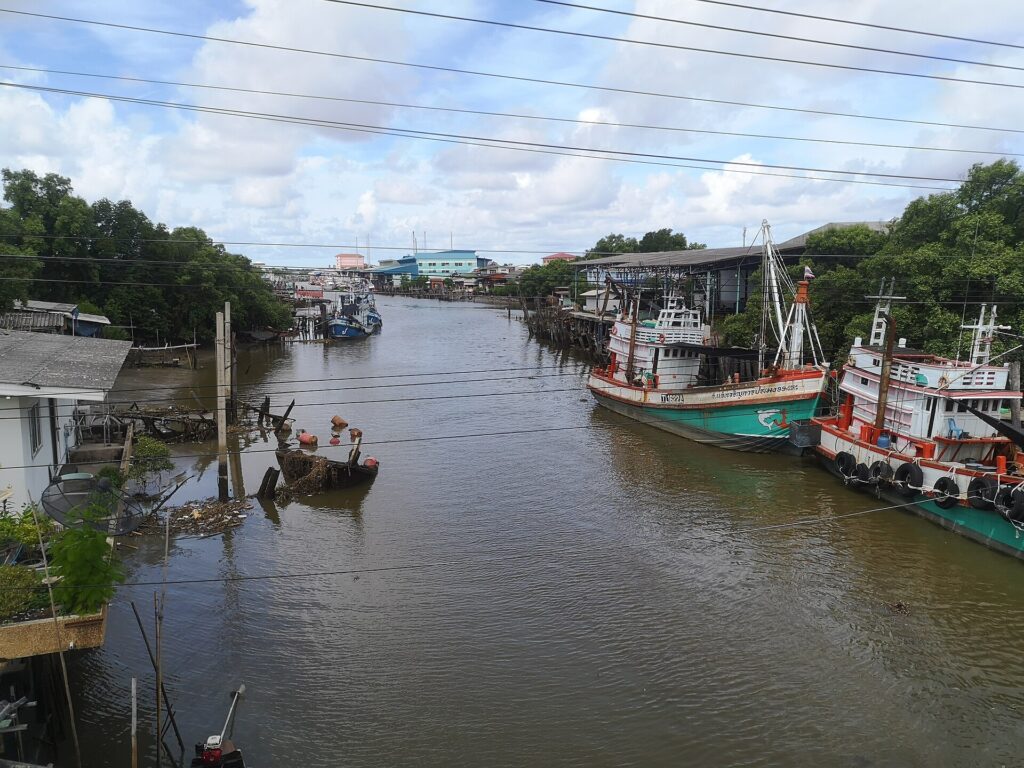
Her mother did little to check. She took Ampan along on her yearly boat trips to the Klong Bang Chag area at harvest time, and on one of them Ampan recognised the village of Bang Chag, but they did not look for the family. Stevenson took this as a sign that the families had not known each other: if her mother had known of a boy who drowned there, she would surely have gone to see them.1
Identification
In 1961, when she was seven, Ampan pointed out a woman in the street of Klong Darn as ‘my aunt’. Meeting her again, she told the woman that she was her mother’s older sister and gave her parents’ names, Tai and Bai. The woman was Joy Ruang Gun, whose younger sister Tong Bai Puang Pei and her husband Tai had lost a son, Chuey, who drowned near their house at Bang Chag in about 1950, when he was about four. She took Ampan and her mother to meet the family.1
At Bang Chag, Ampan embraced Chuey’s mother and, from a boat, picked out his father among three men despite attempts to mislead her. She mentioned a second house and banana and coconut trees that were no longer there by then. At the temple of Wat Bang Plee Noi she picked out Chuey’s older brother Chuan, by then about twenty and a monk, from a group of monks, and identified two of Chuey’s cousins among them.1
Investigation
Ian Stevenson heard of the case in 1963 through a newspaper report, and investigated in July 1966 with Francis Story, returning in 1969 and 1971. He interviewed fourteen people from both families and the temple, setting aside two whose testimony he judged unreliable. He listed 33 statements and recognitions, 19 of them made before the families met. Most were confirmed, though some were not specific: red jars and reddish dogs, he noted, were common in the area. The testimony had more discrepancies than usual, which he put partly down to poor interpreters in 1966.1
Nobody had seen exactly how Chuey drowned, and no one in his family had suspected a snakebite until Ampan said so. Stevenson thought it possible that a snake had startled him and he then drowned, but the snakebite was never verified. Accounts also differed over whether Chuan had been pulling Chuey’s leg in the water, as Ampan seemed to say.1
Birthmark
Before Chuey’s body was cremated, his great-aunt Tong Puang Pei put a spot of red ochre on his upper chest, a custom in parts of Asia and West Africa meant to identify a person when reborn. Ampan had a round, darker birthmark about 1.2 centimetres across just below her left collarbone. The great-aunt could not remember which side of the chest she had marked, so the match cannot be confirmed, but Stevenson learned of the birthmark before he learned of the marking.1
It was the first experimental birthmark case Stevenson investigated, and he later summarised it in Reincarnation and Biology. Because the families had not known each other, Ampan’s mother could not have known about the mark, which in his view ruled out a ‘maternal impression’ as the explanation.2
Behaviour
As a child Ampan had markedly boyish ways: she preferred boys’ clothes, liked boxing, and said she would rather be a boy because boys had more freedom. By fifteen she had moved towards more feminine interests, though she still wished she were a boy. She showed no fear of water, and a dislike of snakes faded as she grew up.1
At twelve she also described what happened after Chuey died: a man took her to a ‘place of dead persons’, she climbed a ladder to heaven and met a large man dressed in white, and was then given fruit to eat before being reborn. Stevenson noted that by that age she could have absorbed Thai beliefs about the time between lives.1
Assessment and later life
Stevenson could not rule out some slight, casual contact between the families, who both used the same market towns, but thought it unlikely and saw nothing for Ampan’s family to gain. He thought extrasensory perception a weak explanation because Ampan described the household as it had been in Chuey’s time, not as it was in 1961. Her recognition of Chuan, who had grown from a child into a young man, he thought could not easily come from memories of Chuey’s life alone.1
Ampan’s memories lasted longer than usual: at fifteen she still remembered details of the drowning, and the two families kept visiting each other. She later married an American serviceman and moved to the United States, and Stevenson was unable to trace her after 1978.1