

Overview
Katsugoro was born in 1815 in Nakano, a farming village in Musashi province west of Edo (now Tokyo), the second son of a farmer, Genzo. In late 1822, when he was eight by the Japanese count, he told his sister that he had been Tozo, son of Kyubei of the nearby village of Hodokubo. Tozo had indeed died of smallpox in 1810, aged six, five years before Katsugoro’s birth.2 The case was written down in 1823 by a local official, a retired feudal lord and a leading scholar, making it one of the earliest documented cases of its kind.23
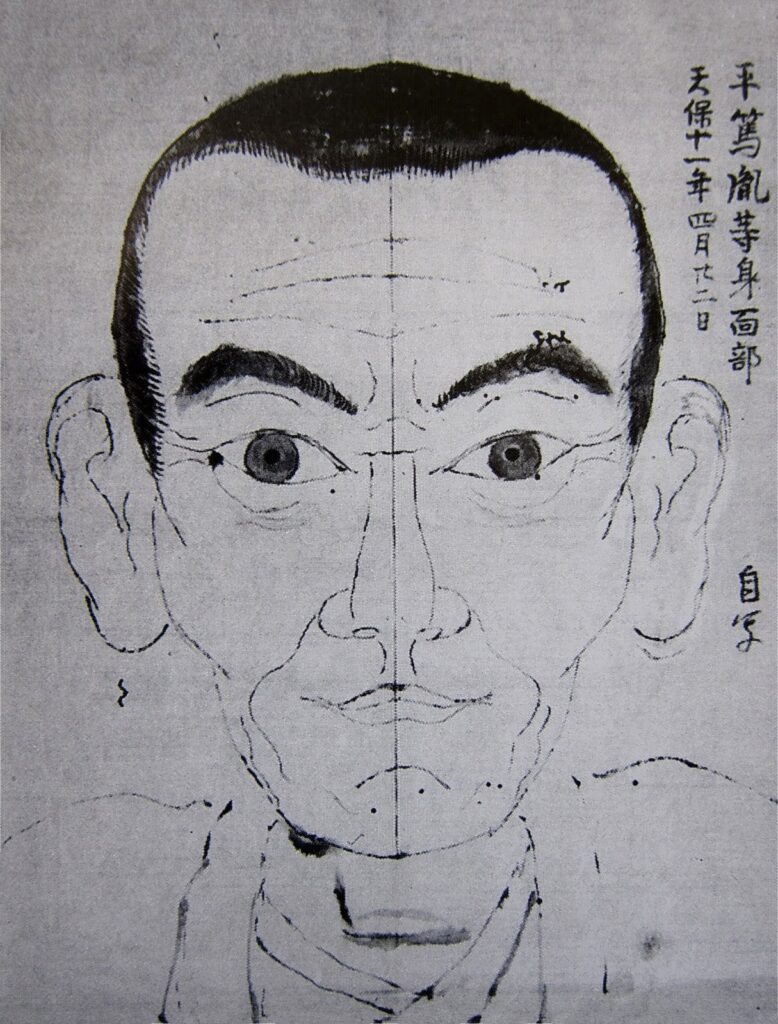
What Katsugoro said
In the eleventh month of 1822, while playing in a rice field, Katsugoro asked his elder sister Fusa where she had been before she was born, and told her that he remembered being Tozo. He begged her not to tell, and for a while she used the threat whenever they quarrelled, but their parents overheard and questioned them. He told them that his father, Kyubei, had died when he was five, that a man called Hanshiro had then taken his place and been kind to him, and that he had died of smallpox at six. He named his former mother, Shizu, and kept asking to visit Kyubei’s grave.2
Between lives
Sleeping beside his grandmother Tsuya at night, he told her he had been put in a jar and buried on a hill, and had then gone home and rested by his pillow. An old man who looked like a grandfather led him away through the air, in a light like an endless sunset; he felt no heat, cold or hunger, heard his family’s voices and the prayers chanted for him, and breathed the steam of rice cakes offered at the family shrine. The old man brought him to Genzo’s house and said he would be reborn there. He waited under a persimmon tree and then in the garden while it seemed his present mother might have to go into service in Edo; when the plan was dropped he slipped in through a knot-hole, stayed by the hearth for three days and entered her womb, and his birth was painless.2
None of this could be checked, apart from his burial: the family record says Tozo was buried in the graveyard on the hill above the village.2 Ohkado Masayuki notes that a modern Japanese boy, Tomo, described a place between lives much like the one Katsugoro described.1
The visit to Hodokubo
Genzo felt it would seem forward for a man to make inquiries himself, so on the 20th day of the first month of 1823 Tsuya took the boy to Hodokubo. When she pointed at nearer houses he said it was further on, then ran ahead to one house and said this was it. It belonged to Hanshiro and Shizu, whose son Tozo had died at six thirteen years before. He pointed out that the roof of a tobacco shop opposite and a tree had not been there before, which was true. In this account the couple wept and remarked that he was better-looking than Tozo had been; afterwards the families visited each other and he was taken to Kyubei’s grave.2
The records
The earliest record is a report by the official in charge of Genzo’s village to his superior, dated the fourth month of 1823. It says the village headman and elders had looked into the matter; that Hanshiro had come to Genzo’s house and found the boy’s descriptions of his former parents’ looks and of their home correct, and thought he resembled Tozo; and that people came daily from other villages to see him. It puts this meeting before the boy’s visit to Hodokubo, the reverse of the grandmother’s account.2
Ikeda Kanzan, a retired feudal lord, went to Nakano on the 22nd day of the third month of 1823 and wrote down the grandmother’s account, which the priest Teikin of Sengakuji temple copied. The dossier also lists both households, with Tozo’s death on the fourth day of the second month of 1810 and Kyubei’s in 1809, when Tozo was five.2 The scholar Hirata Atsutane interviewed Katsugoro and his father and published a book the same year.3 Lafcadio Hearn translated the documents from a manuscript copy in a private Tokyo library as ‘The Rebirth of Katsugoro’ (1897), which made the story known in the West. He offered no verdict on the case, valuing it mainly for what it showed of popular beliefs about rebirth.2
Later life and research
As a child Katsugoro was shy and hid when visitors came. The villagers called him ‘Hodokubo Kozo’; he said he would rather not become a priest, and predicted that he would die at sixteen.2 In fact he later studied with Hirata, married and died in 1869. Ohkado has re-examined the original documents, and a local research group linked to the Hino City Museum published a report in 2015, including a note of Shizu’s own words. Ohkado observes that Katsugoro’s case inspired Ian Stevenson to begin his research on children who remember past lives, yet no further Japanese case was reported until 2011.1